
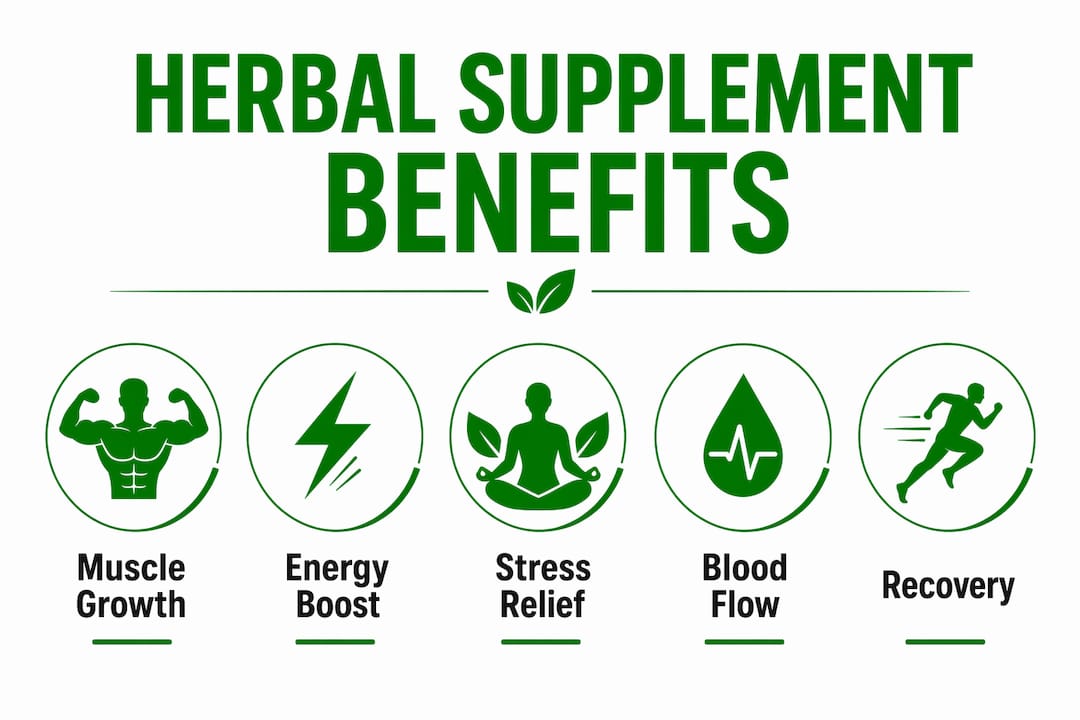
Certain herbal supplements genuinely improve gym and athletic performance, and the clinical evidence from 2024–2026 makes a compelling case for several specific plants. Ashwagandha, beetroot, Cistanche deserticola, and Rhodiola rosea stand out as the herbs with the strongest support from randomised controlled trials. What makes these natural performance boosters different from synthetic stimulants is their multi-mechanistic action: they work through adaptogenic stress resilience, nitric oxide-mediated blood flow, and mitochondrial ATP production simultaneously rather than forcing a single stimulant pathway. The key caveat is consistency. Clinical improvements typically appear after several weeks of daily use, not after a single dose.
Here is what the evidence shows these herbs can do for you:
- Strength gains: Ashwagandha and Cistanche deserticola both increase one-repetition maximum (1RM) bench press and squat performance in resistance-trained individuals.
- Endurance: Beetroot juice and Gynostemma pentaphyllum improve aerobic efficiency and time-to-exhaustion through distinct but complementary pathways.
- Recovery: Adaptogenic herbs reduce cortisol and oxidative stress markers, accelerating physiological adaptation between training sessions.
- Hormonal balance: Several herbs modulate free testosterone and cortisol levels, supporting the anabolic environment needed for muscle growth.
- Mitochondrial energy: Gynostemma pentaphyllum and Cordyceps species enhance cellular respiration, improving ATP availability during sustained effort.
Which herbal supplements are most commonly used for gym performance?
The herbs below represent the most researched and widely used natural performance boosters available to UK gym-goers today. Each brings a distinct physiological role, and understanding those roles helps you choose the right plant for your specific training goal.
- Ashwagandha (Withania somnifera): An adaptogenic root from Ayurvedic medicine, used to reduce stress hormones, support testosterone production, and improve muscle strength and recovery. One of the most studied herbs for gym performance.
- Beetroot (Beta vulgaris): A potent dietary nitrate source that raises nitric oxide levels in the blood, improving oxygen delivery to working muscles and reducing the energy cost of exercise.
- Ginseng (Panax ginseng and Eleutherococcus senticosus): Traditionally used to combat fatigue and support stamina. Its active compounds, the ginsenosides and eleutherosides, are theorised to influence the hypothalamic-pituitary-adrenal axis and reduce the catabolic effects of cortisol.
- Rhodiola rosea: A golden root adaptogen used in strength and power sports. It enhances anaerobic performance by supporting ATP-PC energy reserves and improving neural motor unit recruitment.
- Cistanche deserticola: A parasitic desert plant with a long history in Chinese medicine, now attracting serious clinical attention for its effects on muscle strength and post-exercise recovery.
- Gynostemma pentaphyllum: A climbing herb from East Asia, valued for its ability to modulate mitochondrial respiration and improve aerobic capacity over several weeks of consistent use.
- Sphaeranthus indicus: An Ayurvedic flowering plant whose extracts have demonstrated anabolic and endurance-enhancing effects in recent clinical trials when combined with Mangifera indica.
- Mangifera indica (mango bark): Used in combination with Sphaeranthus indicus in the proprietary blend LI12542F6, it contributes to strength gains, improved body composition, and hormonal modulation in resistance-trained men.
These herbs span traditional medicine systems from Africa, Asia, and South America, yet all share one quality: they work through the body’s own regulatory systems rather than overriding them with synthetic stimulants.
What does the science say about how these herbs actually work?
The most important shift in sports nutrition research over the past two years is the move away from single-mechanism thinking. Effective natural performance enhancement involves multi-mechanistic pathways including nitric oxide-mediated blood flow, mitochondrial ATP production, and metabolic homeostasis, rather than simple stimulant effects. That distinction matters practically: herbs that work through several pathways tend to produce broader, more durable benefits than a caffeine hit.
Nitric oxide and blood flow
Beetroot juice is the clearest example of nitric oxide enhancement in action. Through the nitrate-to-nitrite-to-NO pathway, beetroot supplementation taken a few hours before exercise reduces the oxygen cost of exercise and improves time-to-exhaustion across multiple endurance modalities. The peripheral effects include improved microvascular perfusion and reduced ATP turnover during moderate-to-high-intensity effort.
Adaptogenic stress resilience
Ashwagandha produces significant increases in muscle mass, strength, and VO2max alongside lower cortisol levels after 8 weeks of supplementation. The mechanism is adaptogenic: by reducing the physiological stress response, ashwagandha allows the body to recover more fully between sessions and maintain a more anabolic hormonal environment. Rhodiola rosea works through a related but distinct route, enhancing anaerobic performance by increasing ATP-PC reserves and improving neural motor unit recruitment, which is why it suits strength and power athletes particularly well.

Mitochondrial energy production
Gynostemma pentaphyllum operates at the cellular level, gradually modulating mitochondrial respiration to improve oxidative capacity. A 4-week trial using 450 mg daily of Gynostemma pentaphyllum leaf extract improved 20 km time trial performance by 4%, with a mean improvement of 112 ± 61 seconds. This is not a stimulant effect. The benefits accrue gradually through changes in cellular respiration, which is why continuous intake over several weeks is required.
Key clinical outcomes at a glance
| Herb | Dosage | Duration | Key outcome |
|---|---|---|---|
| Ashwagandha | 600 mg/day | 8 weeks | Increased muscle strength, VO2max, lower cortisol |
| Beetroot juice | 300–600 mg nitrate | 2–3 hrs pre-exercise | Reduced oxygen cost, improved endurance |
| Cistanche deserticola | 5 g/day | 8 weeks | 1RM bench press 64.16 kg vs 56.04 kg placebo |
| Rhodiola rosea | 200 mg/day | Acute and chronic | Improved ATP-PC reserves, motor unit recruitment |
| Gynostemma pentaphyllum | 450 mg/day | 4 weeks | 4% improvement in 20 km time trial |
| LI12542F6 (Sphaeranthus indicus + Mangifera indica) | — | 56 days | Bench press increases vs placebo at day 14 |
A note on trained versus untrained individuals
The research consistently shows that untrained individuals tend to see larger absolute gains from herbal supplementation than trained athletes, simply because their baseline is lower. Trained athletes still benefit, but the effect sizes are more modest. This mirrors the pattern seen with creatine and other well-established ergogenic aids.
Limitations in the current evidence
Study heterogeneity remains a genuine challenge. Trials vary in extract standardisation, dosing protocols, participant training status, and outcome measures, making direct comparisons difficult. The NIH’s health professional fact sheet on dietary supplements for exercise performance notes that results vary by training level, activity type, and environmental conditions. Ginseng is a useful example of this complexity: despite decades of research and theoretical support for its anti-fatigue effects, well-controlled studies have largely reported no significant effect on cardiovascular or aerobic endurance performance in healthy athletes.
Safety, side effects, and what you need to know before you start
Herbal supplements carry a safety profile that is generally favourable compared to synthetic ergogenics, but they are not without risks. Understanding those risks puts you in a much stronger position to use them confidently and effectively.
Common side effects by herb
- Ashwagandha: Generally well tolerated at standard doses. Mild gastrointestinal discomfort is occasionally reported. Avoid during pregnancy due to potential uterotonic effects.
- Beetroot juice: Transient gastrointestinal discomfort and a harmless reddening of urine and stools (beeturia). Blood pressure may drop, particularly in individuals already taking antihypertensive medications or phosphodiesterase-5 inhibitors.
- Ginseng: Insomnia, headaches, and digestive upset at higher doses. Long-term use above recommended amounts may affect blood pressure.
- Rhodiola rosea: Generally well tolerated. Mild stimulant-like effects (restlessness, dry mouth) reported at higher doses, particularly when taken late in the day.
- Cistanche deserticola: Trials using 5 g daily for 8 weeks reported no adverse events, with haematology and clinical chemistry markers remaining within normal ranges.
- Gynostemma pentaphyllum: No significant adverse effects reported in short-term trials at 450 mg daily.
- LI12542F6 (Sphaeranthus indicus + Mangifera indica): The 56-day clinical trial reported no adverse events, with all vital signs and clinical chemistry markers within normal ranges throughout.
Recommended dosages
| Herb | Typical daily dose | Duration |
|---|---|---|
| Ashwagandha | 300–600 mg extract | 8–12 weeks |
| Beetroot juice | 300–600 mg nitrate equivalents | Acute (2–3 hrs pre-exercise) |
| Rhodiola rosea | 200 mg extract | 4–8 weeks |
| Cistanche deserticola | 5 g extract | 8 weeks |
| Gynostemma pentaphyllum | 450 mg leaf extract | 4+ weeks |
| LI12542F6 blend | — | 56 days |
Drug interactions to be aware of
Beetroot juice can potentiate the blood-pressure-lowering effects of antihypertensive drugs and phosphodiesterase-5 inhibitors. Ashwagandha may interact with thyroid medications, immunosuppressants, and sedatives. Rhodiola rosea has mild monoamine-modulating properties and should be used cautiously alongside antidepressants. Anyone on prescription medication should speak with a GP or pharmacist before adding any herbal supplement to their routine.
The UK regulatory picture
In the United Kingdom, herbal supplements are regulated as food supplements under the Food Supplements (England) Regulations 2003, administered by the Food Standards Agency (FSA). Unlike licensed herbal medicines, food supplements do not require pre-market approval for safety or efficacy. This means product quality can vary considerably between brands. Professional bodies including the NIH warn about quality variability and contamination risks in the herbal supplement market. Third-party testing by organisations such as Informed Sport, NSF International, or Labdoor provides independent verification of purity and potency.
Professional athletes competing under UK Anti-Doping (UKAD) rules should use only Informed Sport-certified products. Contamination with prohibited substances is a documented risk in the broader supplement market, and a positive test carries consequences regardless of intent.
Pro Tip: When buying herbal supplements in the UK, look for products carrying the Informed Sport or NSF Certified for Sport logo. These certifications mean the product has been batch-tested for over 200 substances on the World Anti-Doping Agency (WADA) prohibited list.
How to integrate herbal supplements into your training for real results
The gap between a supplement that works in a clinical trial and one that works for you in the gym often comes down to how you use it. Timing, consistency, and pairing with the right training stimulus all shape your results.
Match the herb to your training goal
Herbal interventions work best when matched to training type: adaptogenic herbs like Rhodiola rosea suit strength and power sports, while beetroot concentrate benefits endurance-oriented training. Ashwagandha sits in the middle, supporting both strength and aerobic capacity through its hormonal and recovery effects. If you train for both, ashwagandha is the most versatile starting point.
Timing your supplementation
- Beetroot juice: Take 300–600 mg of nitrate equivalents 2–3 hours before training for maximum nitric oxide elevation during your session.
- Ashwagandha: Daily supplementation at any consistent time works well. Many people take it in the evening given its mild cortisol-lowering effect, which can support sleep quality and overnight recovery.
- Rhodiola rosea: Morning or pre-training use is preferable, as its mild stimulant properties can interfere with sleep if taken late.
- Gynostemma pentaphyllum and Cistanche deserticola: These are daily supplements, not pre-workout options. Their benefits build gradually through consistent use, so timing within the day matters less than taking them every day.
Build the foundation first
Herbal supplements work on top of good training and nutrition, not instead of them. The NIH notes that a few dietary supplements might enhance performance only when they add to, but do not substitute for, a solid dietary foundation. Adequate protein intake, progressive overload in training, and sufficient sleep are the non-negotiables. Herbs amplify a good programme; they cannot rescue a poor one.
Practical steps for getting started
- Start with one herb at a time so you can assess its effect clearly before adding another.
- Commit to at least 8 weeks before evaluating results, as strength gains and hormonal modulation require daily supplementation over at least 8 weeks to manifest reliably.
- Track your performance metrics (1RM, time-to-exhaustion, recovery quality) so you have objective data rather than impressions.
- Source products from reputable UK suppliers who provide certificates of analysis and use standardised extracts.
- Consult your GP before starting if you have any existing health conditions or take prescription medication.
Pro Tip: If you are new to herbal supplementation, ashwagandha is the most evidence-backed starting point for general gym performance. Pair it with beetroot juice on training days for a complementary nitric oxide effect, and you are covering both the recovery and the acute performance angles simultaneously.
You can also explore how natural supplements boost workouts through multiple pathways beyond simple stimulation, which helps set realistic expectations for what consistent herbal use can achieve.
What does cutting-edge research reveal about newer herbal candidates?
The most exciting developments in herbal gym performance research involve plants that were largely unknown outside specialist circles five years ago. Three in particular, Cistanche deserticola, Gynostemma pentaphyllum, and the LI12542F6 blend of Sphaeranthus indicus and Mangifera indica have now accumulated enough controlled trial data to warrant serious attention.
Cistanche deserticola: strength gains from the desert
A randomised controlled trial found that 5 g daily of Cistanche deserticola extract for 8 weeks produced bench press strength of 64.16 kg versus 56.04 kg in the placebo group, and squat strength of 78.12 kg versus 67.70 kg. These are meaningful differences in resistance-trained individuals, not beginners. The proposed mechanisms include modulation of anabolic hormones and reduction of exercise-induced muscle damage markers, though the precise molecular pathways are still being characterised.
Gynostemma pentaphyllum: mitochondrial performance from within
Gynostemma pentaphyllum’s performance benefits come from a fundamentally different mechanism than most gym supplements. Rather than acutely raising stimulant levels, it enhances mitochondrial oxygen flux over several weeks of continuous intake. The 4% improvement in 20 km time trial performance observed in the trial reflects genuine changes in cellular respiration efficiency. Critically, there is no immediate caffeine-like energy boost; users who stop after a week and notice nothing are missing the point entirely.
LI12542F6: the Sphaeranthus and Mangifera combination
The proprietary blend LI12542F6, combining Sphaeranthus indicus flower head and Mangifera indica bark extracts, has produced some of the most striking results in recent herbal performance research. In a randomised controlled trial, bench press strength in the LI12542F6 group increased compared to placebo at day 14 alone, with total gains continuing over the study duration. Time to exhaustion on a treadmill also improved more in the supplemented group than placebo. The blend also improved free testosterone and cortisol ratios, lean body mass, and mid-upper arm circumference, with no adverse events reported throughout.
Emerging mechanisms: inflammation and anabolic signalling
What unites these newer herbs is their apparent ability to modulate inflammation and anabolic hormone signalling simultaneously. Sphaeranthus indicus has documented anti-inflammatory properties, and Mangifera indica bark contains mangiferin, a polyphenol with antioxidant and anti-inflammatory activity. Together, they appear to create a physiological environment that supports both muscle protein synthesis and faster recovery from training-induced damage.
Summary of novel herb trial data
| Herb / Blend | Dosage | Duration | Primary outcome | Trial design |
|---|---|---|---|---|
| Cistanche deserticola | 5 g/day | 8 weeks | Bench press 64.16 kg vs 56.04 kg placebo; squat 78.12 kg vs 67.70 kg placebo | Randomised controlled trial |
| Gynostemma pentaphyllum | 450 mg/day | 4 weeks | 4% improvement in 20 km time trial (112 ± 61 sec) | Controlled trial |
| LI12542F6 (Sphaeranthus indicus + Mangifera indica) | — | 56 days | Bench press increases vs placebo at day 14 | Randomised, double-blind, placebo-controlled |
What still needs more research
These results are promising, but each trial has limitations. Sample sizes are relatively small, most studies focus on young men, and long-term safety data beyond 8–12 weeks is limited for Cistanche deserticola and the LI12542F6 blend. Replication in larger, more diverse populations, including women and older adults, is needed before these herbs can be recommended with the same confidence as ashwagandha or beetroot. That said, the mechanistic rationale is sound, the short-term safety data is clean, and the effect sizes are large enough to justify continued investigation.
For those interested in how stamina-boosting herbs translate into real-world endurance and vitality, the overlap between gym performance and broader physical resilience is worth exploring further.
Key takeaways
Herbal supplements for gym performance work best when matched to your training goal, taken consistently for at least 8 weeks, and sourced from third-party tested products.
| Point | Details |
|---|---|
| Consistency is non-negotiable | Clinical strength and hormonal benefits require daily supplementation for at least 8 weeks to appear reliably. |
| Match herb to training type | Rhodiola rosea suits strength and power sports; beetroot concentrate benefits endurance training; ashwagandha supports both. |
| Beetroot timing matters | Take 300–600 mg of nitrate equivalents 2–3 hours before exercise for peak nitric oxide elevation during your session. |
| Quality verification protects you | Seek third-party tested products (Informed Sport or NSF) to avoid contamination and banned substances, especially under UKAD rules. |
| Novel herbs show strong early data | Cistanche deserticola (5 g/day, 8 weeks) produced bench press of 64.16 kg and squat of 78.12 kg versus 56.04 kg and 67.70 kg placebo in resistance-trained individuals. |
Recommended
- Why natural supplements boost workouts: 2026 guide – Gear 1 4Real African Bitters
- Benefits of herbal sexual enhancement drinks: 2026 guide – Gear 1 4Real African Bitters
- Stamina boosting herbs for men: top 10 picks – Gear 1 4Real African Bitters
- Root herbs for erections: the 2026 science-backed guide – Gear 1 4Real African Bitters